Category Archives: books poetry lit

Eleanor Writes She’s Reading Rimbaud

No one’s serious at seventeen.
—by A. Rimbaud

I’ve been reading Rimbaud again & I must confess
that his beautiful nights & scents of vineyards & beer
his green lindens—all of it—takes me back, a little,

even though I know better than to get nostalgic,
to those early years in Cortland, the smell of apples
like a sweet red fog all over town when the orchards

bloomed each fall. We’d work a day shift at Smith Corona,
lie in the dark fields at night. I can still hear the cars
rushing by on the highway, see the stars overhead,

so many more than I’d ever seen back in Brooklyn.
It all seemed so romantic, the gun in the glove box,
a shoe box stash of acid & speed, a boy whose touch

on a pool cue brought him to my room early mornings,
flush with cash he’d taken off the dumb-bunny freshmen
at the college up the hill. I swear we even played

that scene, tossing bills over ourselves, high & naked,
in my narrow bed. I don’t want to think of our lies,
our petty thieving, how we stitched kangaroo pockets

into the linings of our coats. Or how for weeks we
lived on boosted steaks & candy. I don’t want to think
again of next-door L., how her toddler stared all day

out the window above the crummy bar where she danced,
while she & her junkie lover slept off their latest
derangement. All I ever gave that kid was a wave

of my hand. Still, some days she wants out, that girl I was,
wants them back — her reckless nights & slow, stoned afternoons.
Sometimes the air is so sweet that you close your eyes

-Susan Eisenberg, via Blackbird

Don’t Go Far Off

Don’t go far off, not even for a day, because —
because — I don’t know how to say it: a day is long
and I will be waiting for you, as in an empty station
when the trains are parked off somewhere else, asleep.

Don’t leave me, even for an hour, because
then the little drops of anguish will all run together,
the smoke that roams looking for a home will drift
into me, choking my lost heart.

Oh, may your silhouette never dissolve on the beach;
may your eyelids never flutter into the empty distance.
Don’t leave me for a second, my dearest,

because in that moment you’ll have gone so far
I’ll wander mazily over all the earth, asking,
Will you come back? Will you leave me here, dying?

-Pablo Neruda

Illustration Love: Hug

couplelove
“But now, my love, we are here, we are now, and those other times are running elsewhere.”

― A.S. Byatt, Possession

The Last Ride Together – Robert Browning

painter's honeymoon

The above painting has been a favorite since I first laid eyes on it as a kid – an incredibly tender portrait of a young married couple on their honeymoon, done by Sir Frederick Lord Leighton, an English pre-Raphaelite painter in the 19th century. The details are more vivid in a larger version, but I’m always struck but how delicately he holds her hand, and the attitude of complete trust with which she leans on him, every flow and line of her body and dress falling in to that movement.

I also always associated it with a favorite romantic poem – “The Last Ride Together” by Robert Browning. The old Victorian poets are still the masters of romance – this epic, delicate poem charged with love and longing is a childhood favorite – and it wasn’t until recently that I realized how appropriate it was that I’d always associated the intense tenderness of these two works (the painting and the poem) together, because there is in fact a connection – Leighton was commissioned by Robert Browning to design Elizabeth Browning’s gravestone.

In “The Last Ride Together,”  two lovers ride together before being parted.

I said–Then, dearest, since ’tis so,
Since now at length my fate I know,
Since nothing all my love avails,
Since all, my life seem’d meant for, fails,
Since this was written and needs must be–
My whole heart rises up to bless
Your name in pride and thankfulness!
Take back the hope you gave,–I claim
Only a memory of the same,
–And this beside, if you will not blame;
Your leave for one more last ride with me.

Continue reading

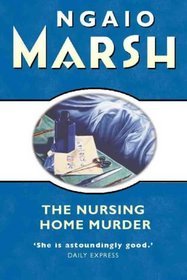
Book Review: The Nursing Home Murder by Ngaio Marsh

nursinghomemurder

The Nursing Home Murder, Ngaio Marsh

When Britain’s Home Secretary Derek 0’Callaghan dies shortly after an emergency appendicitis operation, no-one at first suspects foul play. But his wife is convinced someone killed him, and the autopsy shows poisonous levels of hyoscine, a drug used during the operation. Chief Inspector Alleyn is called in, and finds that very nearly everyone in the room had a reason to kill 0’Callaghan: the nurse was his ex-lover, the surgeon was in love with the nurse and furious at O’Callaghan for breaking her heart, and the secondary nurse is a Bolshevik sympathizer who believed 0’Callaghan was ruining the country.

This is Ngaio Marsh’s third book in the Alleyn series, and it’s not very good: it’s neither a good Marsh novel nor a good mystery in general. The plot is relatively complex; multiple suspects, all with opportunity and good motives, and about a dozen red herrings appear, in particular the victim’s sister as a suspect. It’s also difficult to keep track of the exact order of events during the operation; 0’Callaghan receives three separate injections, all administered by different people – all suspects – and none of this part becomes clear until Alleyn stages a reconstruction of the operation toward the end of the novel. Had Marsh placed this reconstruction toward the beginning, the actual events, and the stakes at play, would have been much clearer and the reader would have been given more reason to be invested. As it is, it is not infrequently confusing, and this isn’t helped by the majority of the suspects being rather stupid, uninteresting people, drawn by Marsh with one-note characterizations. Sir Robert Phillips, the surgeon and an old friend of the Secretary’s, is the only interesting one, and even his purpose in life is reduced to a blind infatuation with one of the nurses.

All in all, this is perhaps the weakest Marsh I’ve read so far. The characteristics that would make her later books so satisfying – her incisive character sketching, the warmth and humor of Inspector Alleyn, her ability to turn a plot on a small, overlooked detail – are only faintly present – the stirrings of a great writer trying to break through inexperience. Her later Alleyn novels show an incredibly developed confidence and prowess for plot; this is competent but dull.

Pablo Neruda Documentary – “The Poet’s Calling” featuring Lawrence Ferlinghetti, Isabel Allende and more

There’s a documentary about Pablo Neruda in the works, from nonprofit Red Poppy which specializes in promoting Latin America poetry. The documentary is titled “Poet’s Calling” and they’ve managed to get interviews with top poets and Neruda’s friends, among them Lawrence Ferlinghetti and Isabel Allende. See a clip below and read more here


According to the website – “The film is composed of stunning shots of his native land, captivating poetic sequences, and unique archival material. Our interviews are crucial to the storytelling, especially with their breadth of variety. These include his few living close friends, students, bestselling Chilean author Isabel Allende, and legendary poet Lawrence Ferlinghetti.

The intent is to raise social awareness by demonstrating how, through his words, Neruda gave voice to others, and how for Neruda, poetry was a rallying cry for the social function of art: a way to bear witness to social and environmental wrongs. We want viewers to see—and feel–how poetry can illuminate them intellectually, spiritually, and socially.”

It’s not the bed that’s a boat

It’s not the bed that’s a boat

but sleep. On a rumple of waves, two           loosed canoes.

Soon I’ll find you
in your wooden ribs.

I’ll tie a rope. I’ll climb on.

-Corinna McClanahan Schroeder in Cellpoems

Premonitions and Stately Building

I hear the dead sea move
In my legs, waves overhead

Child, the wild jetty-walk
Man, the echoed illusion

Pure eyes in the woods
Weeping seek the hospitable head

-Nancy Naomi Carlson translating René Char, via Sakura Review

Let’s Rainbow Rowell It Up in Here

Rainbow Rowell is one of my favorite authors, and indisputably one of the best young adult novelists out there. So have two bits of deliciousness today.

First, Buzzfeed did a great interview of her, from Ashley Ford who goes by smashfizzle on Tumblr –

“The first time Rowell wrote about the struggles of her childhood was in her column for the Omaha World Herald. Her voice lowers a bit, serious but without shame. “I was living in rural areas often without power or a phone or a car. Our water came from a well and a pump. My dad was not around and when he was around, he was not good. There was a lot of alcohol abuse and drug abuse. I feel like I need to say that I’m probably sane and alive because I had a really great mom. Eventually, when we moved to the city and we were on welfare, it was a step up. Being poor in the city was easier than being poor in the country.”

Despite their living conditions, Rowell remembers a home where her father read her The Lion, The Witch, and The Wardrobe. Books were her safe haven. “My mother was very strict, there was very little on television that we were allowed to watch, there were very few movies that we were allowed to watch. But she’d let me read anything.”

And a favorite Youtube book reviewer Polesandbananas covered Landline with her usual pizzazz –

“Fray” by Joss Whedon

In your dreams, you’re someone else. A slave. A princess. A girl in school in a sunlit city.

FrayHeaderI’ve been reading Joss Whedon’s “Fray”, and I am very in love with it. Set in a chaotic, dystopian future world in which crime runs rampant and the gap between the wealthy and the poor has divided all of society, it’s focused on Melaka Fray, a street kid who has made a living as a skilled thief. Manhattan, where she lives, has become a deadly slum run by mutant crime-lords and corrupt or disinterested cops, and Melaka’s only family is her estranged sister, a cop. One moment, Melaka Fray is fulfilling another job for her crime boss, and the next, he’s paid her extra for the job, cut off all ties with her, and she’s being hunted by multiple assassins.

It’s fascinating and badass and the world is like a cross between the cyperpunk grittiness of Dark Angel and the sardonic one-liners of Veronica Mars. It’s not particularly unique – it’s very much a combination of previous Whedon projects – but there’s so much flare here. And something entirely magical about the character of Melaka, a great blend of vulnerability and utter, effortless cool.