My friend Arkae Tuazon, better known as Kajo, has released a music video for the first single off his upcoming album, a summery, shimmering beat about inspiration and hope.
If I fall short are you okay with that

Art and shiny things…
My friend Arkae Tuazon, better known as Kajo, has released a music video for the first single off his upcoming album, a summery, shimmering beat about inspiration and hope.
If I fall short are you okay with that

Everywhere they turn, the walls ask, why, why not.
From every space someone calls a question
and there echoes so many answers, it’s impossible to hear.
Save me, he calls.
Open me, she calls. Divorce me.
Their despair is a bird in an abandoned nest,
its brother has jumped out and died, its sister is dying beside it
and still it perches:
Do I fly?
Can I fly?
You’re here because you said,
I hate you instead of, I’m sorry.
You’re here because you couldn’t forgive
but kept on making stews and hand-washing his good socks,
blowing curses into hot water.
-Ladan Osman, Apogee

No. 6, Vol. 1
No. 6 is a 6-volume sci-fi graphic novel series written by Atsuko Asano and drawn by Hinoki Kino

My friend Nathan McClain was interviewed for Collagist, and while some of the information is outdated – he now lives in New York and has been widely published – it’s a good read.
Nathan McClain lives and works in Los Angeles. His poems have recently appeared or are forthcoming in Quarterly West, Nimrod, The Journal, Toad, Linebreak, and Best New Poets 2010. A recipient of scholarships from Vermont Studio Center and the Bread Loaf Writer’s Conference, he is currently an MFA candidate at Warren Wilson College.
His poem, “Love Elegy in the Chinese Garden, with Koi,” appeared in Issue Forty-Nine of The Collagist.
Here, he speaks with interviewer, Darby K. Price, about botanical gardens, hindsight, and Elegance vs. Beauty.
Can you tell me a little bit about the origins of “Love Elegy in the Chinese Garden, with Koi”?
Well, the cause of the poem (if we’re considering the poem itself as an effect) was an excursion to the Huntington Botanical Gardens in Pasadena, CA. I’d met an attractive woman, who also seemed attracted to me, and we took this trip together—as friends. As you might imagine, there was good amount of tension and anxiety between us as we moved through the gardens. As a result, my early drafts of this poem, originally a triptych, attempted to explore the sense of anxiety between two people who could potentially become lovers.
Such were the years, a dumb stuffed thing
to say, if truth is we all grow old un-
observed, limbs flail only halfway up
a flight, where does dark begin settling
my little bones. I dream and do love
to have them, blue fish
in a lake, my head more tipped up than down
under damp earth. Some days others like deer
from the shot, peeled back, how nuisance I
find trees dressed in wild
green light. The years come, unstitched
a face, saddled as one would a heavy beast
for walking, likely I became then a member
of heaven, put up, the years come and reaching
their long wet hands.
-Wendy Xu, Guernica

rt Sarah Breese
“The desire to fly is an idea handed down to us by our ancestors who, in their grueling travels across trackless lands in prehistoric times, looked enviously on the birds soaring freely through space, at full speed, above all obstacles, on the infinite highway of the air.”
– Orville Wright (the Wright brothers)

2)The First Shop of Coffee Prince(Korean)
Coming in at #2 is much-loved, wildly famous Coffee Prince, starring Gong Yoo and Yoon Eun-Hye.

Eun-chan (Yoon Eun-Hye) plays a girl who’s had to grow up quickly in order to keep her family going after the death of her father. When a wealthy, irresponsible coffee-shop owner mistakes her for a boy and hires her to pretend to be his boyfriend so that his family will think he’s gay and let him off the marriage hook, a whole series of events are set in motion. When Eun-chan later goes to work at his coffeeshop, an intense attraction springs up between the two – but he still thinks she’s a man.
My take: Coffee Prince is just standout in Korean dramas – it’s well-written, well-acted, well-directed, with a lovely soundtrack featuring indie artists and stellar performances from both Gong Yoo and Yoon Eun-hye; it’s funny, offbeat, and romantic, doesn’t drag until perhaps the very end, has a cast of charmingly quirky(and good-looking!) supporting characters, has an unconventional romance trope(guy falls in love with girl whom he thinks is a guy), and even more importantly has that extra spark of magic that just pulls a whole drama together and makes it out-of-the-world amazing.
When it gets good/Got me! moment: end of second episode
Fav scene: it’s tied between The Kiss(you know the one;) and the bumping-into-each-other on the street as they’re both picking up what she dropped
3)Nobuta wo Produce (Japanese)
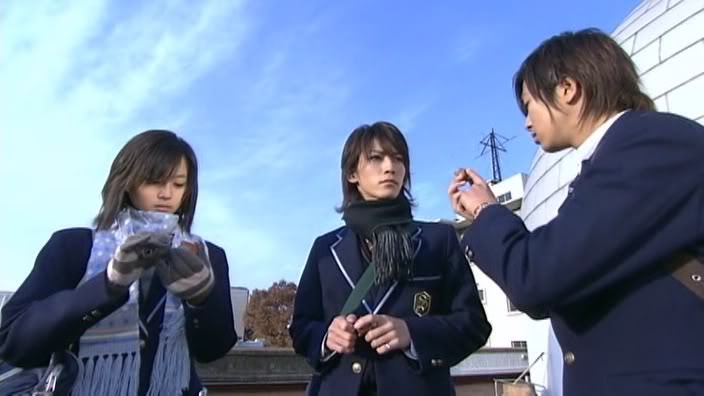
Popular, good-looking Kiritani Shuji (Kame) has it all – the unofficial king of his high school, he’s loved by everyone from the cool kids to the nerds. There’s just one person Shuji doesn’t get along with – Akira. The quick-talking, hyperactive Akira rubs Shuji in all the wrong ways. When odd, reserved new girl Nobuko enters the school, she is immediately, viciously bullied. Shuji and Akira agree to work together to transform her into the school queen. An unlikely friendship springs up between the trio.
My take: I came late to the Nobuta fanwagon late, but when I did I fell hard. It was universally recommended to when to try when I first tried Jdramas, and while I liked it then, I just didn’t get it, and stopped after a few episodes. Two years later, with 9 other jdramas under my belt, I tried it again…and magic happened. It instantly shot past all the other jdramas I’d seen to become, not just my favorite jdrama, but one of my favorite dramas ever. And this for a show with very little overt romance!
It pitch-perfect, superbly acted (Kame as Kiritani Shuuji is basically a cross between Ferris Bueller and Jim Stark and won the Japanese equivalent of an Emmy for his lead role), well-produced and directed (light and dark are often interestingly played with and there’s just some lovely shots peppering it throughout), and completely funny, sometimes heartbreaking, and completely heartwarming. A love story, a coming of age tale, a romance, family, and friendship epic. It’s brilliant. It has something for everyone.
When it gets good: I already loved it by the end of the first episode, but the second episode solidified that
HONOURABLE MENTIONS: Prosecutor Princess, Brilliant Legacy, Aishiteiru to itte Kure, Hana Yori Dango 1 &2, Yamato Nadeshiko Shiche Henge, My Lucky Star, Silence, Wish to See You Again, ToGetHer, and Smiling Pasta. These are all dramas which are well-written, compelling, and hugely enjoyable, which I definitely recommend watching if you haven’t seen yet, but just didn’t quite have that spark of consistent magic that I require in my top dramas, or just don’t have my heart in the definitive way the others do.
NEXT: Favorite Asian dramas #6-9

I don’t know what to do with my wife’s grief,
How she clutches my shirt,
Weeps the way Eve wept for Abel,
Sorrow wild, thick as locusts.
She says grief sits in her stomach,
Fills her up like Thanksgiving dinner.
I imagine carving grief, serving it
With stuffing, black and full of onion.
I’m trying to understand
How despair works, how being alone
Is like burying her mother again.
I’m not alone, she says.
When you leave, grief crawls
Into bed with me. I can’t say no.
I can’t close my eyes, turn my back.
At night, in the dark, I lie
Next to my wife, put my arm across
Her sleeping body, feel her chest
Rise and fall, slow as a funeral.
If I press my ear to her breast,
I will hear the sound Eve made
When God introduced her to death.
-Martin Achatz, Mayapple Press


 Coffee and Irony