Category Archives: books poetry lit

4 Books For People Who Like Character Driven Novels

4characterdrivennovels2Broke and Bookish launched this book theme for the week, so I thought I’d participate. They did 10 but I’m lazy and write longer descriptions because I get carried away so you’re getting four.

1. Eleanor and Park, Rainbow Rowell. I’ve mentioned my love for Rainbow Rowell several times before, if you haven’t read her yet, she practically defines character-driven works. Eleanor and Park is a linear novel in that there are almost no characters featured at all beyond the central two; it’s a deep dive into the minds and personalities of two intelligent, outcast teens. Eleanor is a curvy loner with a unique clothing style and a troubled home life. Aloof Park is respected but left mostly alone due to being one of the only Asians at the high school. After a first, tentative connection on the bus, Eleanor stars reading along with him on the comic books he reads every day on the way to school. They forge a slow, tender, passionate connection over a shared love for music and comic books. It’s one of the best love stories I’ve ever read, and Rowell isn’t afraid to show the push and pull, tension and release, the intense obsession and curling joy and turbulence that comes with that epic first love.

2. The Portrait of a Lady, Henry James. You didn’t really think I could answer this without including the book featuring Isabel Archer, one of the most complex and also identifiable female heroines ever, right? I don’t like most of James’ other works, but this – it feels as though James is sitting behind me reading my thoughts. Isabel Archer is an American of good birth and no money until an elderly acquaintance spontaneously leaves her a huge fortune. She finds love, misfortune, and a lot of societal complications as she travels between Europe and England and finally settles down in Italy. It’s the most perceptive book I’ve ever read about how women think, in the same way that Nick Hornby captures how men think in his funny, piercingly accurate prose.

3. A Murder for Her Majesty, Beth Hilgartner. Who read this as a kid? One of the most re-readable books I’ve ever come across, this incredibly engrossing book is technically written for younger/teen readers but it so beautifully plotted and captures the atmosphere of 16th-century Tudor London so vividly, you’re immediately drawn in. Orphaned Alice Tuckfield is on the run, penniless in the rain, having left behind her country home after the sudden murder of her father. She stumbles upon a cathedral and is taken in by a group of choirboys who befriend her and allow her to join them if she masquerades as a boy. Mystery, plots, a gruff tutor who becomes a father figure, and plenty of banter and friendship light up the book. The boys all have distinct personalities and interact with Alice differently, becoming her family, brothers, and friends, and she, plucky, well-educated, and a gifted singer, leaps off the page. Most of the Goodreads reviews of this are from adults who report they couldn’t put it down, and there’s a reason why. So good.

4. Sunshine, Robin McKinley. I am not certain if this is the only adult book Robin McKinley ever wrote, but it’s certainly one of the few. Sunshine has always known there’s something a little different about herself, but since she doesn’t know what it is, she continues living her life as a baker in her small town. One day, however, she’s grabbed and wakes up chained to a wall next to a similarly shackled human-ish creature named Constantine. Things for from there. Sunshine is flawed, and funny, and snarky, and even as she very (very) reluctantly falls in love with the vampire whom she’s been thrown together with and who winds up protecting her from his own kind, she gives him all kinds of hell. This book is immutably gripping and so much better than I can describe, mostly because Sunshine is amazing.

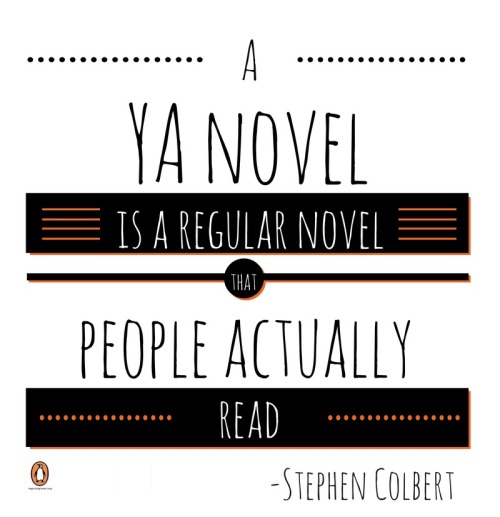
Quotidian: Stephen Colbert

ya novel stephen colbert

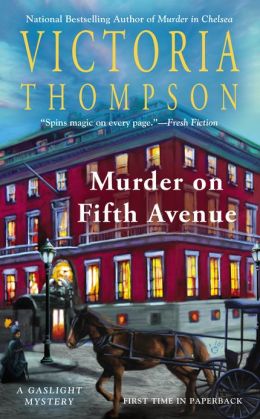
Book Review: Murder on Fifth Avenue

murder on fifth avenueMurder on Fifth Avenue, Victoria Thompson

Midwife/amateur detective Sarah Brandt and Irish detective inspector Frank Malloy return to the streets of New York in this fourteenth book in the Gaslight series, and it’s an odd reversal of strengths and weaknesses for the author. First off, if you’ve never read any of Victoria Thompson’s suberb mystery novels set in turn-of-the century New York City, you should, because they are beautifully atmospheric, and start with Murder on Astor Place, the first. However, if you have, this isn’t the best in the series.

A society man has died in the highly exclusive men’s club managed by Sarah’s father, and he calls in Frank trusting him to both solve the murder and be discreet about it. The first mystery is how and where the man was killed, as he was stabbed before arriving at the club and then slowly bled out with out pain. Frank follows a bizarre trail of secrets that leads him to the Italian mob, an innocent-seeming mistress, and the dark underbelly of wealthy New York society. The plot and pacing are significantly stronger – despite a melodramatic center, the reveals are made gradually and deftly and underscored with enough evidence and character development to make sense. The pacing is sharp and the book is as gripping and perhaps even more gripping than most Victoria Thompson novels – a mini page-turner that is hard to put down.

Continue reading

Poetry: Whale

In every way they come to us, we weigh them in pieces.
At dinner by the shore my sister and I pretend

to pretend we are friends
not shamed by growing up. The whales

are swimming in the cove, and all year
this has been happening—they die and wash ashore

like secrets the kids jab with pointed sticks.
First a great balloon, swelling with each day’s heat,

a smell the wind doesn’t wash away—
weeks in, the skin frays as cooling wax breaks

from a slate. My sister and I are in a cage made of ribs
that we built for each other, we are

in childhood’s oiled tent. Sometimes in our minds
we balance on the whale, feel with our toes

the grooves, the loosing of cells, the melting
inside as the methane grows. The mass of it

even scientists can’t determine.
On the whale we are little again—

she snaps a toy we shared, and I press my palm
over her nose, seal off its edges

and count to five. For five seconds
on the television, biologists weigh bricks

of animal, calculate the weight
of blood lost in the death. Always

I have carried that moment, the power
of releasing my hand, of knowing I could choose my memory.

Eventually the whale becomes
what the mind is: a body threatening to burst.

-Kasey Erin Phifer-Byrne, Word Riot

Faces

She beats the driftwood against her thigh during a break in the squall, with branches and burls culled from debris and dark conversation of wind, water and wood about her feet.
She shakes out sand and rubs the wood on her jeans to shine up the wet pores looking for a face, and finds it, fumbling with a worn-out burl, her snowy cheeks turned scarlet like twin fires on the beach of the morning.

She has discovered a fable to create for her children.

I look, see nothing, and I shall not forget that when she left me that morning the ducks and gulls and the sea turned from tone and sonority to rattle and racket, the caesura and pause of the sand transformed to an endless taut drum by the pounding of the surf.
I shall not forget how I could taste the cold metal my tongue had become without her melting syllables, how wet and warm from the rain at the river’s mouth I stood shoes hung about my shoulders, impoverished of myth, looking at the torment of the sky, the storm in my mouth gone quiet and dry.

-Jeff Burt, Treehouse

Poetry: Ultrasound

I picture her exhausted, drained, snoring
beside her snoring husband, breathless at times,
waking in fits in the dead of night

to wander the darker rooms,
leafing through a blue book of names
her mother left on the kitchen counter,

then groaning back up the hardwood stairs
for the last precious hours of rest
before the next day pushes her along,

before the bells of the 5:30 alarm,
before the cold air waiting to bite when she opens the shower curtain,
before the black drip coffee, before the blueberry yogurt,

before the kiss goodbye that doesn’t last long enough,
before the lone cough in the subway car,
before the frown of the security guard

who hands out plastic badges and points her toward the basement
where she stands beneath fluorescent lights,
signs her name, the day, the time, and admits aloud—I’m here,

I’m here. I need to see the doctor.

I smooth the cool clear gel
gently in small circles
over her stretched and tired body,

and above the thin prism
that separates me from her paper white skin,
I press down gently with the small gray wand

that speaks for me, pauses
to listen to itself, thinks for a moment,
and only then shows me

the black and white echoes of a nearly round head,
the quiver of the heart,
the cord reaching across two worlds

sharing two body heats, sharing the winter air,
sharing a black coffee, sharing the same letters
of another new story, and sharing a brief scene with me.

As I begin to speak, the static shushes impatiently.
Snow falls, and we look at the white screen—hush;
close your eyes,

and I’ll show you again.

-Vikram K Sundaram, [PANK] Magazine

Matins

You want to know how I spend my time?
I walk the front lawn, pretending
to be weeding. You ought to know
I’m never weeding, on my knees, pulling
clumps of clover from the flower beds: in fact
I’m looking for courage, for some evidence
my life will change, though
it takes forever, checking
each clump for the symbolic
leaf, and soon the summer is ending, already
the leaves turning, always the sick trees
going first, the dying turning
brilliant yellow, while a few dark birds perform
their curfew of music. You want to see my hands?
As empty now as at the first note.
Or was the point always
to continue without a sign?

-Louise Gluck

Big Boy Ohio

gets an apron and nametag.

She rolls pennies. The pie case turns
the color of the moon. She fills
coffee cups and sugar boxes.

She fills half-full ketchup bottles
from half-empty so customers believe
they have new natural tomatoes
boiled down and slipped into glass necks

“Hey honey,” they say before they order burgers
so neatly she might be a virgin
who sleeps under a field of stars
and soothes cows for the dinner table.

-Julie Babcock, Decomp Magazine

Ekdekhesthai

Mornings I wake to one place, and at dusk

another. There are many kinds
of sleep. As a child I believed

sleeping with one’s eyes
open was the world

according to John. I called

a ghost, who.
A scarecrow, that.

I wake standing at the window

telling you I don’t see
the fire in the street. I wake
standing in red light

as emergency workers carve a woman
out of steel
horseshoed around the sugar

maple. Sometimes I half
expect to peel a clementine

& find nothing inside.

My mother calls to say
my grandmother just walked down
the hall. My grandmother,
dead for years. I do not know

whether to trust my mother

or the ghost’s side of the story.
All prophets perform
the miracle

of context. As does light.
As do birds in the morning.

-Emilia Phillips, West Branch Wired