
 Far Out is a robot western graphic novel by Montreal-based author Gautier Langevin and designer Olivier Carpentier. You can read it online, and here’s an interview with Langevin that’s a good overview of the inspiration and concept. My favorite bit: “Machines are becoming more and more human, human more and more machine, and as of culture, what else it is but a very powerful technology helping mankind to thrive throughout the tragic wheel of time?”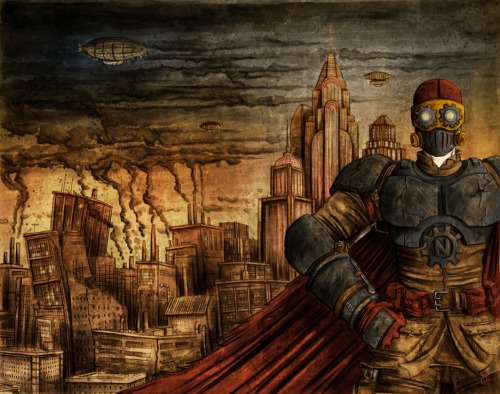
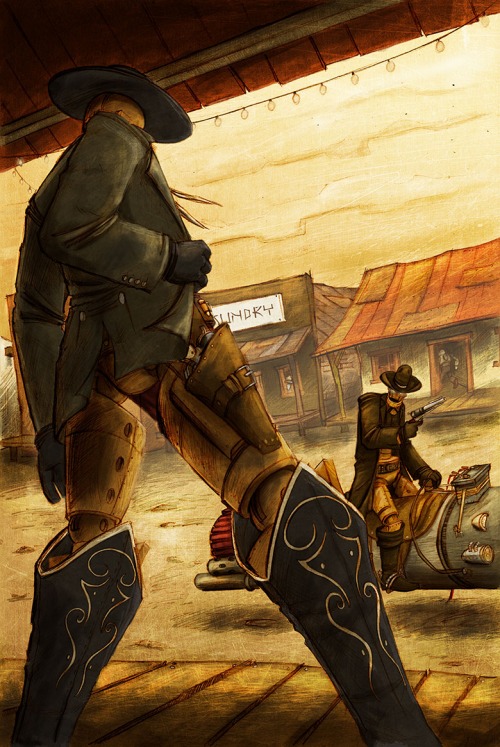
Illustration Love: Robot Western “Far Out” by Gautier Langevin and Olivier Carpentier

Poetry: ‘All the Right Tools’ and ‘Late Aubade’ by James Richardson
These poems by James Richardson left me weak with wonder and the intense love that only words weaved in the way that perfectly resonates with my particular soul can cause. LOVE.
All the Right Tools
It is aggravating to have to stop writing to fix things. We hope these tools
will get you back to the important work faster.
—Inscription in a toolbox, a gift from my parents, 1973
will get you back to the important work faster.
—Inscription in a toolbox, a gift from my parents, 1973
That good slow tool the sun,
with a trumpeter’s strict breath,
swells hemispheres of fruits
to scarlet or dusk or amber
imperceptibly,
not breaking one.
That good slow tool the moon
pulls the quiet
wide-eyed face of the ocean
to its face,
not a drop through its long fingers
slipping down.
That good slow tool that turns
trees and lives to wreckage
brilliant and strange,
that train so smooth and slow
we hardly know we’re on
is Time, but is there one
slower still
that would reverse
these words and call
your breaths and all
your strayed thoughts home
to be you, standing again?
Late Aubade
after Hardy
So what do you think, Life, it seemed pretty good to me,
though quiet, I guess, and unspectacular.
It’s been so long, I don’t know any more how these things go.
I don’t know what it means that we’ve had this time together.
I get that the coffee, the sunlight on glassware, the Sunday paper
and our studious lightness, not hearing the phone, are iconic
of living regretless in the Now. A Cool that’s beyond me:
I’m having some trouble acting suitably poised and ironic.
Share this:

Thoughts While Watching the Thai Version of Full House
 Like many people, my introduction to Asian dramas was with 2004 Korean drama classic Full House. The one, the only, the fairly low-budget, unadorned romantic comedy that has the visual appeal of a documentary and the addicting quality of peanut butter M&Ms, caramel corn and pistachios rolled into one; the drama that started the entire drama and Hallyu movement. I marathoned the whole thing in a few days, and have never looked back since as far as watching Asian television shows. I have a huge amount of affection for it, particularly certain scenes like the “meet-cute-hey-I’ll-throw-up-on-you” on the plane scene and the learning-to-ride-a-bike scene. Having said that, it’s hopelessly dated both thematically and especially in production value, so I was interested to try the recent Thai remake of the drama. Here is my very brief reaction toward episode one.
Share this:

Quotidian: Erin Morgenstern on Storytelling


rt Carried Away
“Someone needs to tell those tales. When the battles are fought and won and lost, when the pirates find their treasures and the dragons eat their foes for breakfast with a nice cup of Lapsang souchong, someone needs to tell their bits of overlapping narrative. There’s magic in that. It’s in the listener, and for each and every ear it will be different, and it will affect them in ways they can never predict. From the mundane to the profound. You may tell a tale that takes up residence in someone’s soul, becomes their blood and self and purpose. That tale will move them and drive them and who knows what they might do because of it, because of your words. That is your role, your gift. Your sister may be able to see the future, but you yourself can shape it, boy. Do not forget that… there are many kinds of magic, after all.”
― Erin Morgenstern, The Night Circus
Share this:

NEEDTOBREATHE “Brother” feat. Gavin DeGraw Lyrics and Official Audio
This is so gorgeous I had to post. Exclusive stream from EW of the latest single off NEEDTOBREATHE’s 2014 album, Rivers in the Wasteland. Featuring Gavin DeGraw (who doesn’t appear on the album version of the song), this is a musical match made in vocal heaven, all richness and depth of chorus and with NEEDTOBREATHE’s trademark far-reaching, catchy melodies. (Lyrics may not be exact as I wrote them myself)
Lyrics under the cut
Share this:

Travel: Amsterdam

Amsterdream, by Romain Mattei
Amsterdam is ripe for rambling, its compact core laced by atmospheric lanes and quarters. You never know what you’ll find: a hidden garden, a shop selling velvet ribbon, a jenever (Dutch gin) distillery, an old monastery-turned-classical-music-venue. Wherever you end up, it’s probably by a canal. And a café. And a gabled building that looks like a Golden Age painting. – from Lonely Planet’s Guide to Amsterdam
Share this:

Caffeinated Links: How to Sustain Creativity and Inspiration, Greatest Action Setpieces in Film History, and What Is Love

Erich Campbell on consuming broadly in order to create with focus – “In my opinion, creativity and problem-solving are cultivated, not granted like a wish; they grow, and like any growing thing they must be fed and cared for, given the proper environment. Once grown, the resultant creativity must be trained and exercised, pruned and the selected offshoots allowed to flower. Taken step by step, I think all people are capable of incredible creativity.” RT
Good read on how Singaporeans have developed a misplaced sense of entitlement in the wake of the city-state’s massive economic success- “The level of materialism – what you wear, where you live, what you drive, what you wear on your wrist – has become a key determinant of the value of human life. This is absolute nonsense.
But it’s the unintended consequence of the fantastic economic success which we have enjoyed. In our headlong rush for more money, a lot of values seem to have been lost.” RT
Incredible video essay mashup of some of the greatest action scenes in film history. Scenes from classics of the past ten years and more including Batman Begins, North By Northwest, Scarface and more. RT Indiewire
Ta-nehisi Coates on the resurrection of the Peter Parker/Mary Jane marriage in the upcoming Marvel comics. “I say this because I knew, from a very early age, that there was love in my house, imperfect love, love that was built, decided upon, as opposed to magicked into existence.That was how Peter loved Mary Jane. They were not destined to be. She was not his Lois Lane. His Lois Lane—Gwen Stacy—was murdered for the crime of getting too close to him, and the guilt of this always weighed on him. Whatever. While the world was fooled, Mary Jane Watson knew Peter Parker was Spider-Man.” RT Atlantic
Share this:

Poetry: ‘The Call’ by C Dale Young
Make sure you click through for the ending because especially in this poem..it’s the most important part.
in memoriam Cecil Young
I am addicted to words, constantly ferret them away
in anticipation. You cannot accuse me of not being prepared.
I am ready for anything. I can create an image faster than
just about anyone. And so, the crows blurring the tree line;
the sky’s light dimming and shifting; the Pacific cold and
impatient as ever: this is just the way I feel. Nothing more.
I could gussy up those crows, transform them
into something more formal, more Latinate, could use
the exact genus Corvus, but I won’t. Not today.
Like any addict, I, too, have limits. And I have written
too many elegies already. The Living have become
jealous of the amount I have written for the Dead.
So, leave the crows perched along the tree line
watching over us. Leave them be. The setting sun?
Leave it be. For God’s sake, what could be easier
in a poem about death than a setting sun? Leave it be.


 Coffee and Irony