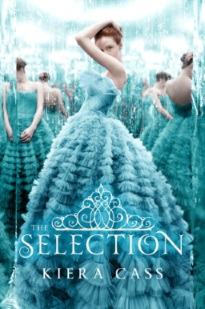
The Selection, Kiera Cass.
America Singer lives in a futuristic America in which, after a series of World Wars, society has been restructured as a class system. There are eight castes who each perform different duties. America is a 5, the artistic case, who earn their money by performing during national holidays and for the wealthier families. Intermarriage between castes is highly frowned upon and America’s mother hopes that she will raise their status and support them financially by marrying into a caste above her. America, however, has been in love with Aspen, the son of a family friend and a caste below her, for her entire life.
The country is governed by a regency and the state announces that it’s time for The Selection, an event in which 35 girls are chosen from a lottery and one of them selected by the Crown Prince to be his bride. America reluctantly enters the drawing at the pushing of her mother, and is shocked when she is chosen. Soon, she and 34 other girls are swept into the palace to live a life of luxury while getting to know the Prince.
This is a light and immensely readable book – I read it in two sittings flat. America is an immediately engaging heroine, mostly the story is told in first person and Kiera Cass makes America spunky and blunt but with believable fragilities and small selfishnesses that make her human. Oddly, however, it’s the first half of the book that’s the strongest – America, her relationships with the various members of her family, and her relationship with Aspen are all well-developed. The romance that develops in the second half, though….there’s exactly enough good romance in this book to make one compelling relationship, not too.
Cass attempts to set up a love triangle between America, Aspen, and Prince Maxon, and several of the scenes with Aspen and Maxom, respectively, are very compelling – but wholistically Aspen and Maxon each feel like half of a fully-rounded character. Aspen is too simple to be completely interesting – the two main drives of his life appear to be to survive and to be with America if he can, and he doesn’t have the complexity to grapple with the changes in America while she lives at the palace, or the broader social and political forces in the country. While Maxon adheres too closely to that “white prince/knight in shining armor” pattern – he’s painfully nice, formal, and innocent for much of the novel. Both male leads would have been more interesting if they had more bite to them, a little more of a rough edge.
Continue reading →

 Reading the Selection series is akin to watching Pretty Little Liars: you don’t know why you’re doing it, but somehow you can’t stop. The Elite is a very silly novel that replicates all the same weaknesses and limitations of the first novel, and yet is oddly entertaining despite that, mostly because there are bits of good romance.







 Coffee and Irony